As with all sections on this website, this area depends on input from the members. If you have anything that would fit these subject areas, please pass it along to me.
Thanks, Fin • FinBeven@MSN.com
Practical Sailor Evaluation: The Cal 40
Written by Darrell Nicholson for Practical-Sailor.com
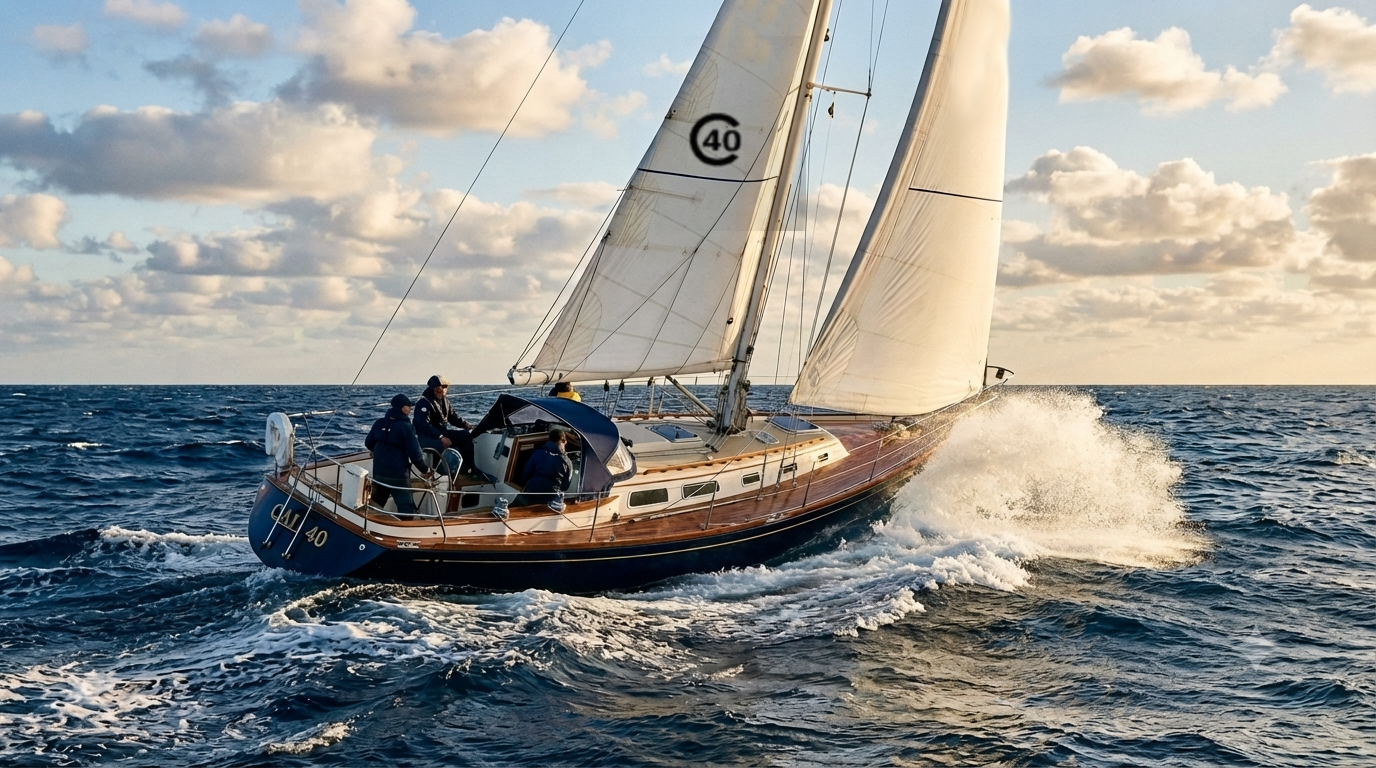
Though now an old and dated design, the Cal 40 was a hot boat when new, and she carries that legacy.
Specifications & Racing Provenance
Thunderbird, a Cal 40 owned by IBM president T. Vincent Learson, took first in fleet over 167 boats in the 1966 Bermuda Race. Because this was the first computer-scored Bermuda Race, Learson got a lot of gaff about the IBM computer that had declared him the winner—and about beating out his boss. Thomas J. Watson, IBM’s chairman of the board, sailed his 58′ cutter, Palawan, second across the line, but ended with second in class, 24th in fleet, on corrected time.
In fact, the computer scoring system was not especially kind to Learson. Both he and Watson would have fared considerably better under the old system that calculated scores from the NAYRU time allowance tables. Thunderbird’s victory was a legitimate win, another in a stunning series by Cal 40s that was establishing the boat as a revolutionary design. The first Cal 40 was built for George Griffith in 1963. That winter, hull #2, Conquistador, took overall honors in the 1964 Southern Ocean Racing Circuit (SORC). The Transpac races of 1965, ’66, and ’67 all went to Cal 40s. Ted Turner’s Cal 40, Vamp X, took first place in the 1966 SORC. In the ’66 Bermuda Race, five of Thunderbird’s sisterships finished with her in the top 20 in fleet, taking five of the first 15, four of the first nine places. And so on. In their first few years on the water, Cal 40s chalked up an astonishing record.
The 40 was the fifth in a line of Cal designs that C. William Lapworth did for Jensen Marine of Costa Mesa, California. Lapworth had already designed a series of moderately successful racing boats, the L classes, including an L-24, L-36, L-40 and L-50, when he teamed up with Jack Jensen. The Cal designs were built on concepts he had tried in his L-class boats. The first Cal was the 24, Jensen’s first boat, launched in 1959. The Lapworth-Jensen team then produced a 20, 30, and 28 before getting to the Cal 40, which proved to be a successful distillation of Lapworth’s thinking up to that time.
“Aspects of the boat that departed from the conventional wisdom were her light displacement, long waterline, flat bilges to encourage surfing, fin keel and spade rudder. The masthead rig is stayed by shrouds secured to chainplates set inboard of the toerail, a then unusual innovation that allows a reduced sheeting angle. The success of the design helped legitimize fiberglass as a hull material, establish Jensen Marine as a significant builder of fiberglass boats, and propel Lapworth to the forefront of yacht design.”
Three decades have passed since Lapworth drew the Cal 40. In that time, using computers to score races has become commonplace—boat measurers and designers would be paralyzed without them. The CCA Rule, the NAYRU tables and the Portsmouth Yardstick have been replaced by IMS, IOR, and PHRF, with the effects of their parameters expressed in the shape, size and weight of new boats. New building materials and techniques have changed the meaning of terms such as “light displacement,” “long waterline,” “fin keel,” and “fast sailboat.” Today the Cal 40 is a dated design, having been surpassed in her revolutionary features by her descendants. She remains among the esteemed elite of racing yachts, but she is not especially light, long on the waterline, or fast compared to current designs.
The Cal’s builder was transformed by time, as well. Jensen Marine was bought by Bangor Punta Marine, and the Cal production line was moved to Florida about the time that the Cal 40 went out of production in 1972. For the next decade, the company’s name and address shifted between combinations of Cal, Bangor Punta and Jensen in California, New Jersey and finally Massachusetts, where it joined O’Day under Bangor Punta’s umbrella in the early 1980s. After 1984 the company was called Lear Siegler Marine, Starcraft Sailboat Products, and finally emerged as Cal, a Division of the O’Day Corporation, in Fall River, Mass. Cal and O’Day ceased production in April, 1989.
Construction & Structural Details
The construction of the Cal 40 is typical of Jensen Marine boats of the 1960s. The hull is solid hand-laid fiberglass with wooden bulkheads and interior structures. Strips of fiberglass cloth and resin secure the wooden structures to the hull, but this tabbing is rather lightweight and has been reinforced in some Cal 40s where it has failed. If it has not been reinforced, it probably needs it. Because saving weight was a priority, the reinforcement provided by the bulkheads and furniture is critical to hull stiffness.
The hull-to-deck joint is an inward-turning hull flange, upon which the deck molding is bonded, then through-bolted and capped with a through-bolted teak toerail. The deck, also a solid fiberglass layup, has reinforcement designed into it during layup, so no interior metal backing plates are provided under winches, cleats, and other hardware. Check lifeline stanchion bases carefully. Ballast is an internal lead casting dropped into the keel before interior assembly.
Wiring was also installed prior to the interior, which makes it quite inaccessible in some areas and low enough to submerge if bilges go unpumped under heel. Re-wiring elevated in accessible locations is strongly recommended. The stock Cal 40 came with a big, sensitive tiller steering system over a wheel setup.
The aluminum mast is stepped through the deck to a fitting at the cabin sole level. The shroud chainplates are secured to a transverse bulkhead at the mast station and tied into an aluminum weldment in the bilges that also supports the mast step.
Sailing Performance & Interior
The Cal 40 is in her element in heavy air, especially off the wind. Her long waterline and flat bilges help her get up and go on reaches and runs, surfing in heavy air. On the wind, the flat hull forward pounds in waves and chop. She carries a PHRF rating between 108 and 120 seconds per mile depending on the region—comparable to late-70s IOR designs like a C&C 38 or Ericson 36.
Inside, the Cal 40 is well-designed and functional for her era. The layout is traditional, featuring a V-berth forward, pilot berths and extension settees in the main saloon, a drop-leaf table with a central stainless steel post and gimbaled mahogany tray, a galley to port, a nav station to starboard, and two aft quarterberths affectionately known as “torpedo tubes.”
Originally powered by Atomic 4, Graymarine 4-112, or Perkins 4-107 engines, most hulls have been repowered with modern diesels (Volvo, Westerbeke, Isuzu). Expect hull prices to range between $40,000 and $50,000 based on overall rigging, finish, and engine condition.
Sinn Fein: News & Restoration Legend
Regular Winners Keep on Keeping On
Sinn Fein, Peter Rebovich’s Cal 40 from Metuchen, New Jersey, beat the other ten boats in Class 1 and the entire 123-boat St. David’s Lighthouse Division for top honors in the 2008 Newport Bermuda Race. This was Rebovich’s fourth successive Class 1 win and his second lighthouse win in a row.
In addition to claiming the St. David’s Lighthouse Division victory, Sinn Fein became the first boat ever to win the North Rock Beacon Trophy for the best corrected time among all 122 IRC-rated boats in the combined St. David’s and Gibbs Hill Lighthouse Divisions.
Crew Roster: Peter S. Rebovich Sr., Gary Gochal, Henry Henning, Peter S. Rebovich Jr., Mark P. Rebovich, Kelly Robinson, and Foster Tallman.
The Sinn Fein Resurrection Blog
When Super Storm Sandy devastated New Jersey in October 2012, one of the many casualties was two-time Newport to Bermuda champion Sinn Fein. Declared a total loss by the insurance company, Pete Rebovich decided to buy the boat back and repair it for future Bermuda Races.
Follow the full restoration blog archived through the Raritan Yacht Club (Questions/Comments: Kelly Robinson at krobins@rutgers.edu):
→ Read the Sinn Fein Resurrection Blog (PDF)George Griffith: 1921–2012
By Blue Planet Times • Published September 11, 2012
REMEMBERING GEORGE “I’LL GUARANTEE YOU TEN BOATS” GRIFFITH
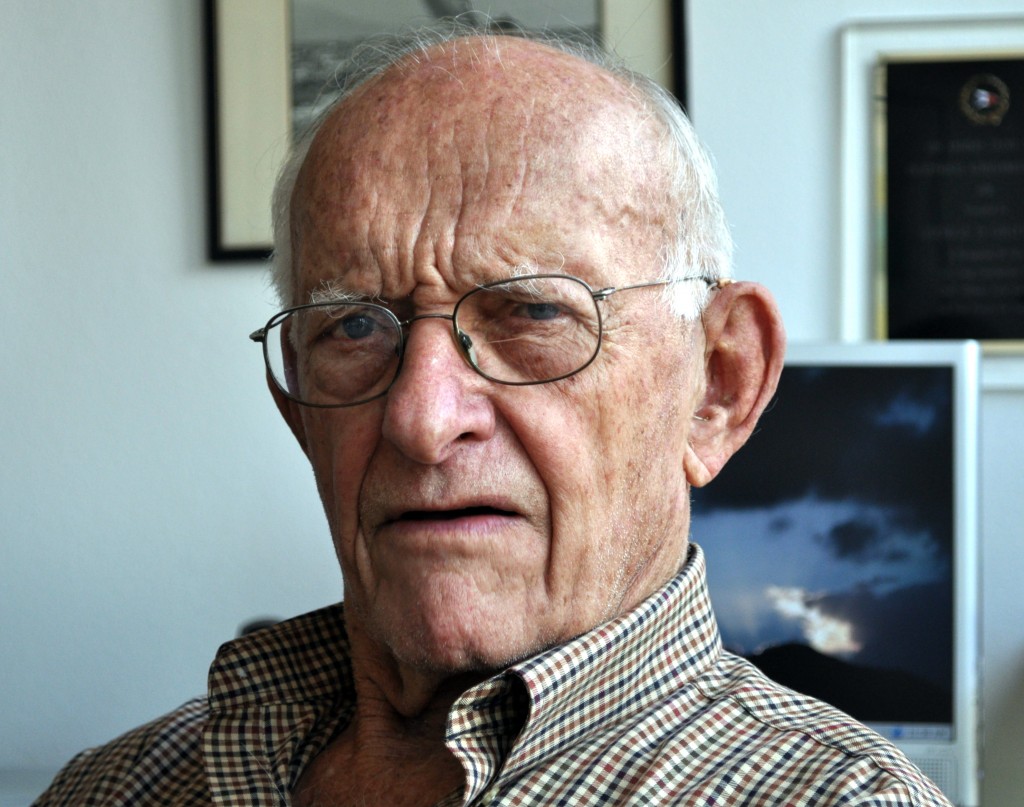
George Griffith rocked my world. The man had a vision for a next boat, and he didn’t care about the doubters. The result was the Cal 40, arguably the most influential raceboat of the second half of the 20th century, and I have it on good authority that George, on his last day of sharing our Blue Planet, had a view of some very fine Cal 40s, moored at Catalina Island, gleaming as brightly as when they rolled off Jensen Marine’s production line in the 1960s.
 George Griffith
 George at Work
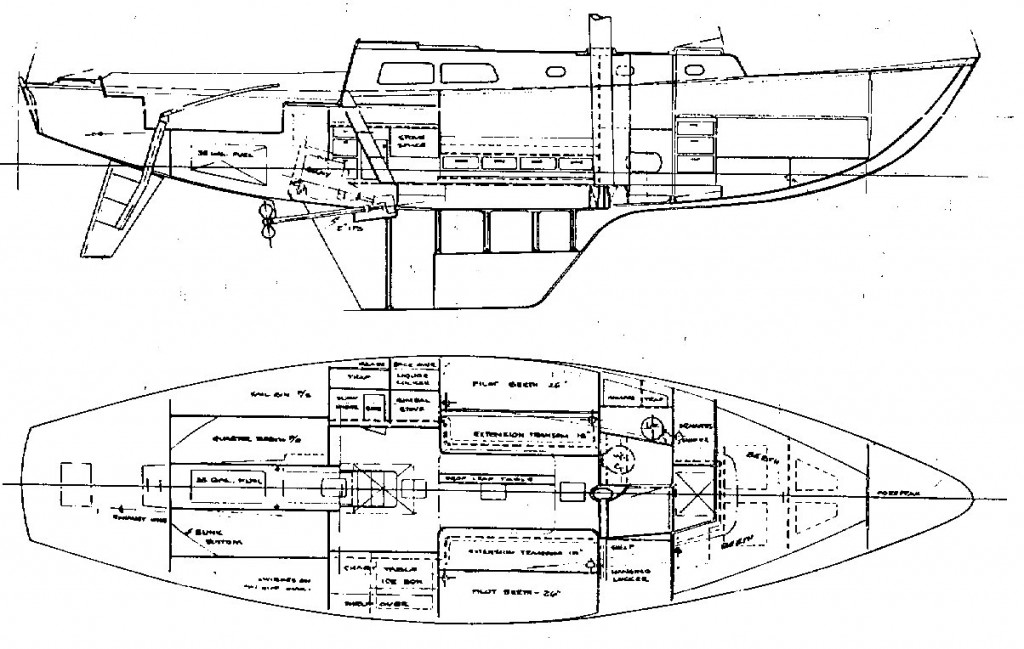 Original Cal 40 Hull Lines
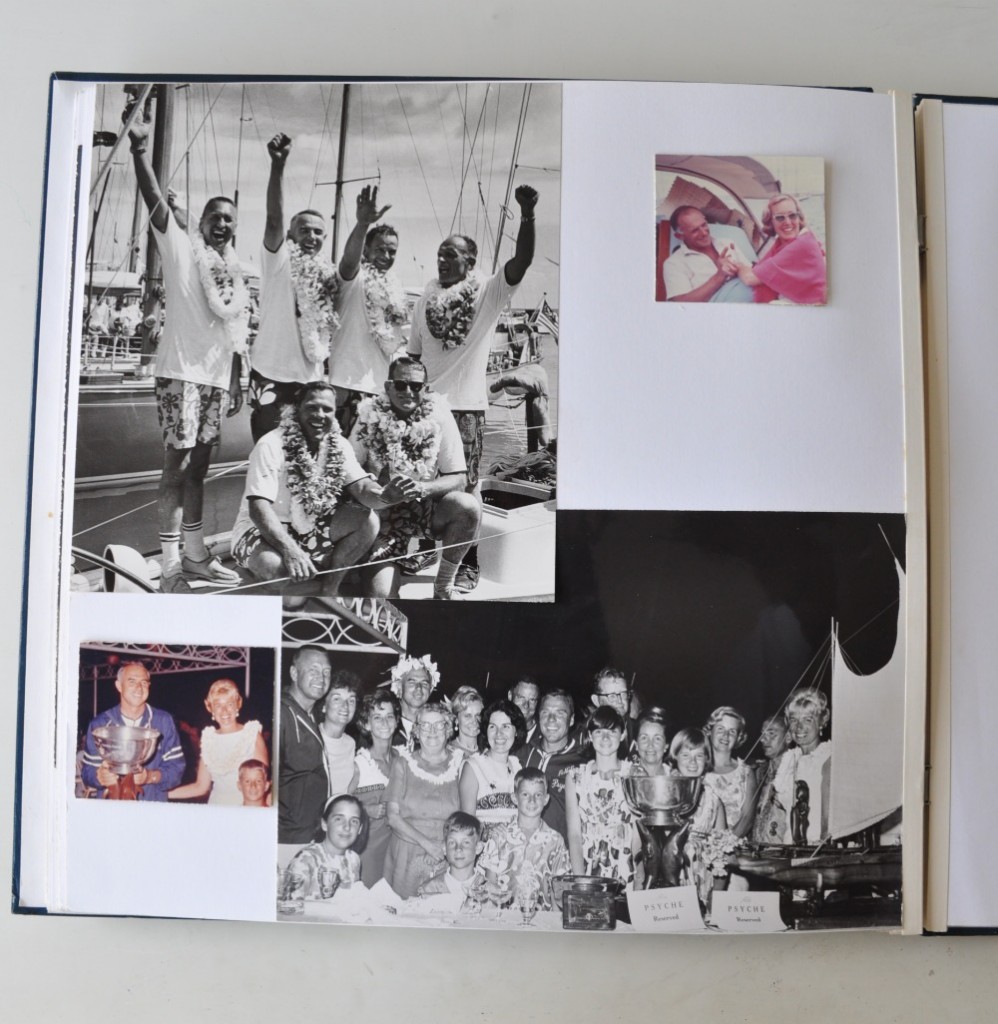 1965 Psyche Crew (George far right)
Born May 9, 1921, George built himself a nine-foot dinghy in 1931. He sailed his first Transpac in 1941, sharing the 45-foot cutter Pajara with his brother, Dave, and finishing second on corrected time. World War II he spent in Houston, Texas building warships.
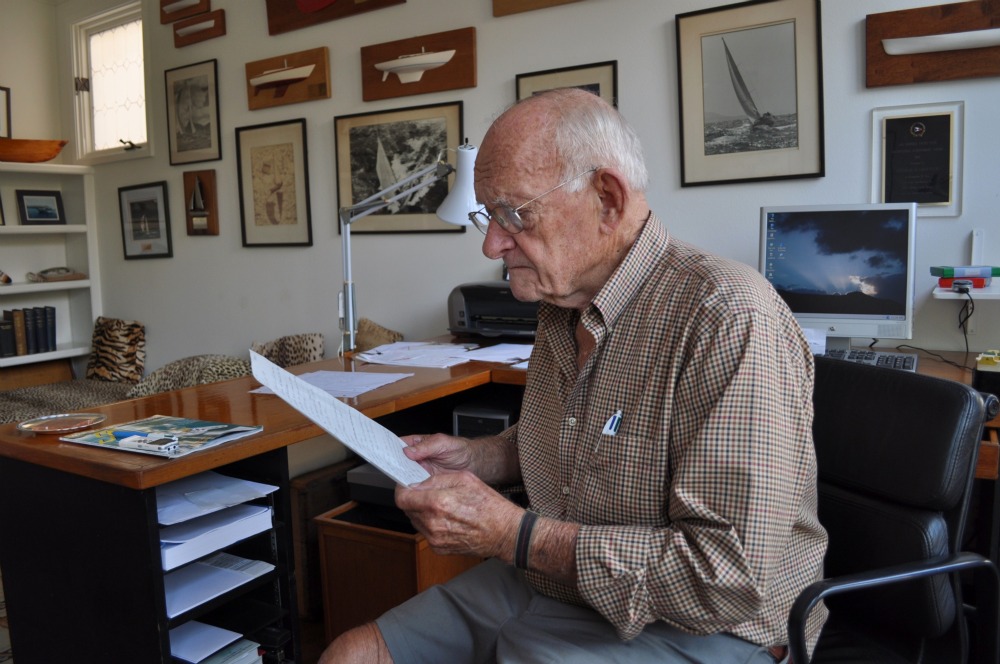
Caltech was the logical place for George’s higher education, feeding that hands-on, experimental bent that never left him. He worked with friend and naval architect Bill Lapworth on the design of a 36-footer, and then a 40-footer, but it was George who sketched out the shallow sections of what would become the Cal 40. He insisted upon the fin keel, spade rudder, and light-for-its-time construction that would make this boat the original downwind flyer. It was George who boldly told the builder, “I’ll guarantee you ten boats.”
In the 1965 Transpac from Los Angeles to Honolulu, Cal 40s finished 1-1, 2-2, 6-3, and 5th-7th in Class C. Downwind distance racing has never been the same since. George sailed that race on overall winner Psyche with skipper Don Salisbury, navigator Ben Mitchell, and builder Jack Jensen.
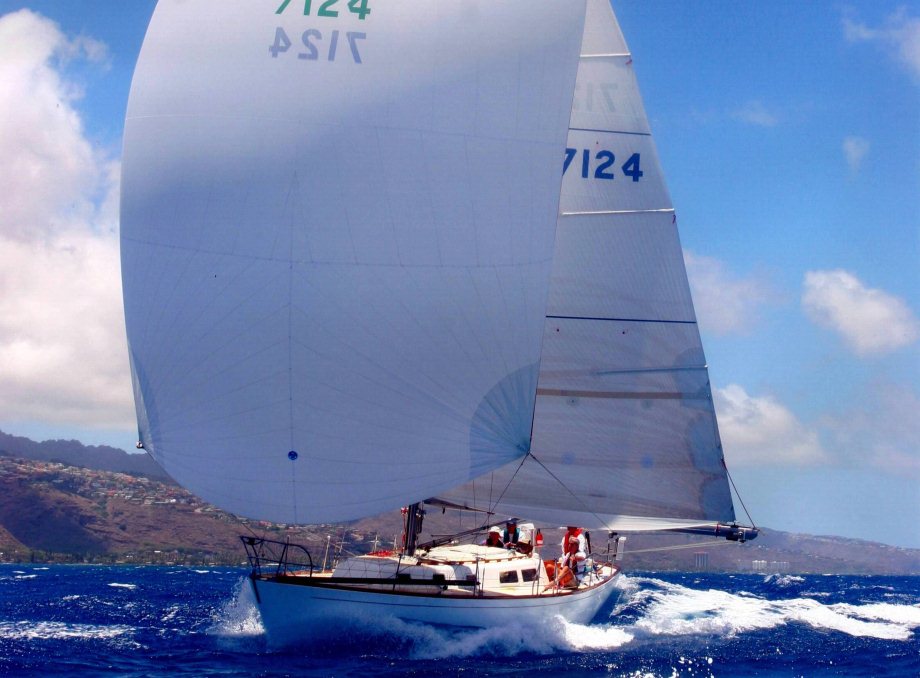 Cal 40 Radiant in action (Photo by Geri Conser)
Technical Manuals & Magazine Downloads
Access historical publications, technical reviews, and owner documentation in PDF format:
Fin Beven's Cal 40 Owner's Manual
Complete guide and owner notes compiled by Fin Beven.
↓ Download Manual (PDF)Perry on Design: Cal 40
By Robert H. Perry, Sailing Magazine (Nov 2006) [10.2 MB].
↓ Download Article (PDF)Vintage Press Archives
Time Magazine & Sports Illustrated historical coverage.