Addressing Structural Weakness in the Shaft Log Area
Over time, several Cal 40 owners have documented water ingress and structural delamination along the centerline seam and shaft log area above the propeller tube. Below are direct insights, findings, and repair approaches from experienced owners and naval architects.
Stan Honey on Illusion:
"On Illusion, early in the period when we owned her, we noticed water weeping into the bilge from that area, and when the boat was hauled out, we noticed some areas between the hull and the shaft log that were slow to dry. Illusion had the fiberglass shaft log from the beginning, so that wasn't the problem.
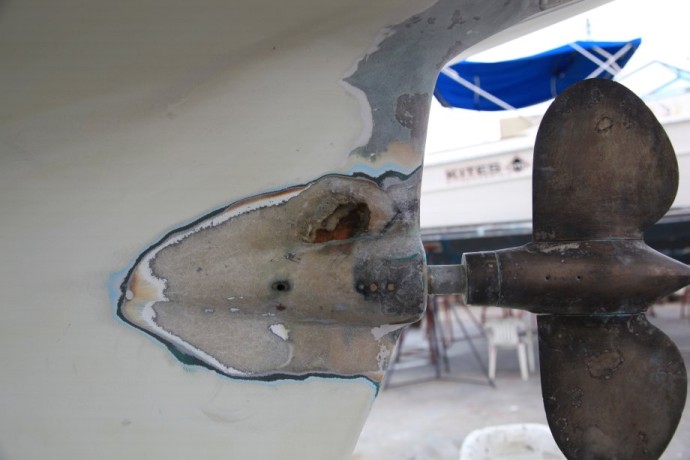
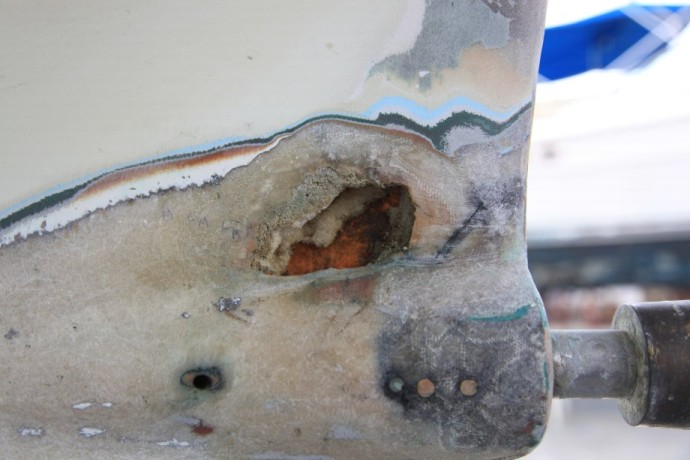
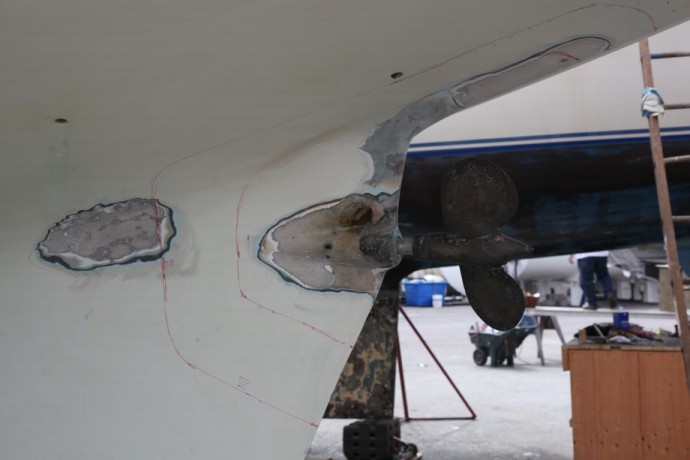
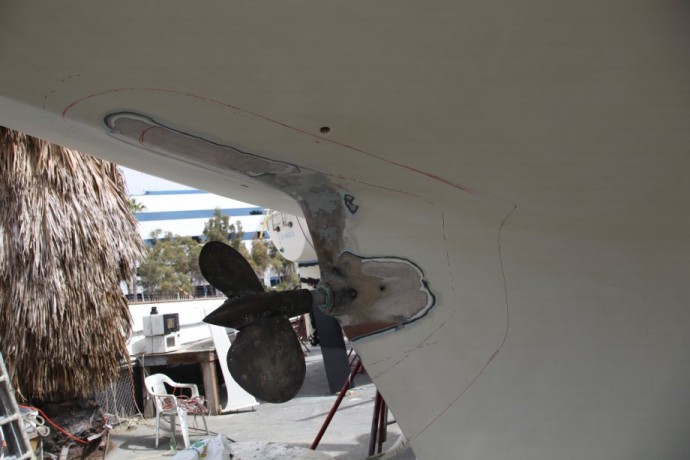
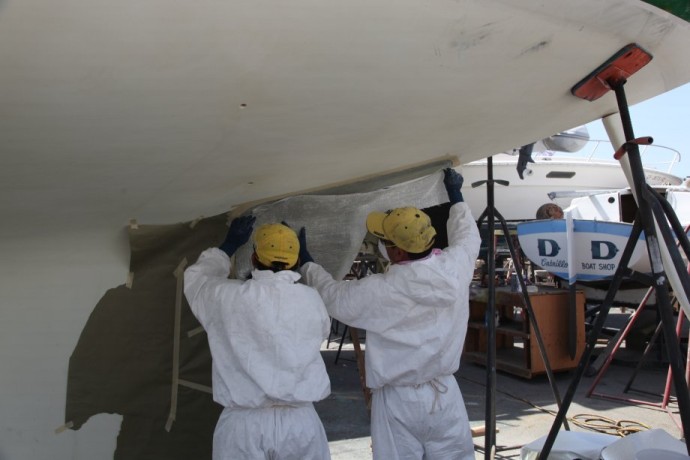
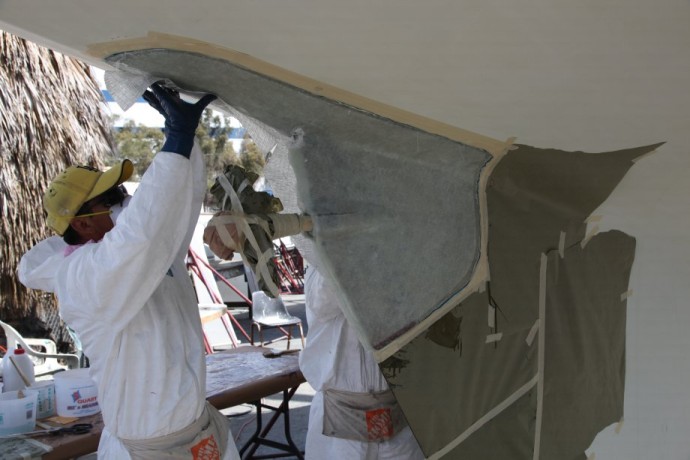
We ground into that area from the outside and found very poor glass work and lots of 'bog' with no glass. Understandably it is so skinny back there that it was hard to do a good layup into the female mold when the boats were built. From the outside we ground out all of the lousy glasswork and bog in that area, back to solid laminate, and then re-laminated from the outside with epoxy. It was easier than it sounds because working from the outside there is easy access.
I think it is worth fixing properly and I'd consider it to be a possible structural problem. As I understand, some folks believe that Tangent was lost because she came apart in this area, but of course nobody really knows. It was a surprisingly easy fix working from the outside."
Doug Jurius on Belle Aurore:
"We had the same problem with Belle Aurore that Stan described, only worse. In 2009 while transiting from the Chesapeake to Marblehead for the Halifax race, we noticed the bilge pump was cycling on every so often. I didn't think much about it as the weather was miserable, pouring rain, wind on the nose, lots of wet people and gear moving into the cabin, etc. The icebox drained to the bilge as well.
After starting the race, noticed that the leaking was increasing to the point the pump was running every 10 minutes or so. Ultimately it became severe enough that we decided to abandon the race. We discovered a 4-inch horizontal tear had developed in the glass directly above the shaft log.
Evaluation by a materials expert indicated that the process Cal used in manufacture wasn't ideal. The insert of those 'casings' that create the hollow for the shaft log create a hard spot in the glass, which combined with the poor glasswork above, caused the glass to delaminate & ultimately tear. We were definitely lucky in that the aft bulkhead in the keel was fairly watertight and limited the inflow."
Kenny Keefe (KKMI Shipyard) on Gone with the Wind:
"In my experience, there have been problems with the center seam in the boat. Partly due to old age and partly due to the way the boat was built. My bet is somewhere along the center line joint from the rudder post to the aft edge of the keel fin, there is a crack / defect that is letting the water in the boat.
Then the tricky part is that it travels between the layers of fiberglass and comes out in some random spot inside the boat. For example, it could be leaking at the shaft log / tube, the water finds its way in there and then runs down a void and exits somewhere, on the inside aft seam in the keel."
Alan Andrews’ Findings & Engineering Assessment
Consulting Naval Architect Alan Andrews evaluated the area on Radiant to establish an appropriate repair schedule:
"The laminate in this area is very thin... Over time and with prop loads, it appears this is just too thin for what is essentially both the prop strut and what the boat is set on when hauled.
The existing laminate appears to be just Mat, Cloth, Mat, Cloth, Roving and less than 1/8" thick. The laminate specified here should be about .36 inches thick... The result may mean removing more of the laminate above the shaft tube and below the hull in order to build this thickness further towards centerline and still keep the fair keel shape. (Increasing the thickness but keeping the original outside shape)."
The repair execution was entrusted to Dennis Choat at Dencho Marine, with haul-out services provided by Don Holland at Cabrillo Boat Yard in San Pedro.
Grinding & Re-Lamination Documentation
Because this condition can potentially manifest on any Cal 40, these photos document the initial grinding inspection and re-lamination phase performed by the crew at Dencho Marine.